
Complete ISO 14001 Guide: Certification, EMS, Benefits & ISO 14001 Certification in Saudi Arabia
Introduction
Sustainability is a must-have for a thriving company. Organizations are expected to have a minimal impact on the environment and operate efficiently with customers, regulators, investors and business partners. From waste reduction to energy conservation, pollution control to meeting environmental standards, companies are increasingly using some of the internationally recognized standards to help them reach their targets.
Currently, ISO 14001 is the best standard available in the market. It offers organisations a structured approach to dealing with environmental responsibilities by developing an Environmental Management System (EMS). Environmental protection should not be the responsibility of an environmental department, but ISO 14001 brings environmental protection into the mainstream business and helps to boost the efficiency of an organization and promote sustainability in the long-term.
Having an environmental management system is really important for a business. It helps to improve the business’s reputation. If a business gets an ISO 14001 certification it means that the business is doing a job of taking care of the environment. For companies that want to get an ISO 14001 certification in Saudi Arabia is very helpful. This is especially true for companies that work in areas where taking care of the environment is very important.
This guide will tell you what ISO 14001 means. It will explain how the environmental management system works. You will also learn about the benefits of having an ISO 14001 certification.You will understand why companies all around the world are using this system.
What Is ISO 14001?
There is now an international standard under ISO called ISO 14001. This sets out the requirements for the design, development, implementation and continual improvement of an Environmental Management System (EMS).
The aim of ISO 14001 is to assist organisations to recognise environmental risks, manage environmental impacts, meet relevant legislation and continually improve environmental performance.
ISO 14001 encourages a proactive attitude toward preventing environmental problems, rather than just meeting up environmental regulations.
One of the biggest strengths of the standard is its flexibility. ISO 14001 can be customized for any size organization, public or private, or for manufacturing products or services.

ISO 14001 Meaning
The question of the ISO 14001 meaning is a question that is asked by many professionals before deciding whether it’s suitable for their organization or not.
Basically, ISO 14001 is a management framework for planning, systematic and measurable management of environmental responsibilities of an organisation.
What is different about ISO 14001 is that instead of responding to environmental incidents that have occurred, organisations recognise in advance what environmental impacts may occur and take steps to control such impacts and mitigate risks.
For example:
- A manufacturing company may reduce waste generated during production.
- A construction company may introduce measures to control dust, noise, and pollution.
- A logistics company may improve fuel efficiency and reduce carbon emissions.
- A training institution may implement environmentally responsible office practices and reduce paper consumption.
Even if these firms work in separate sectors, their approach towards improving their environmental performance is always similar to ISO 14001 standards.
Understanding of the ISO 14001 Environmental Management System
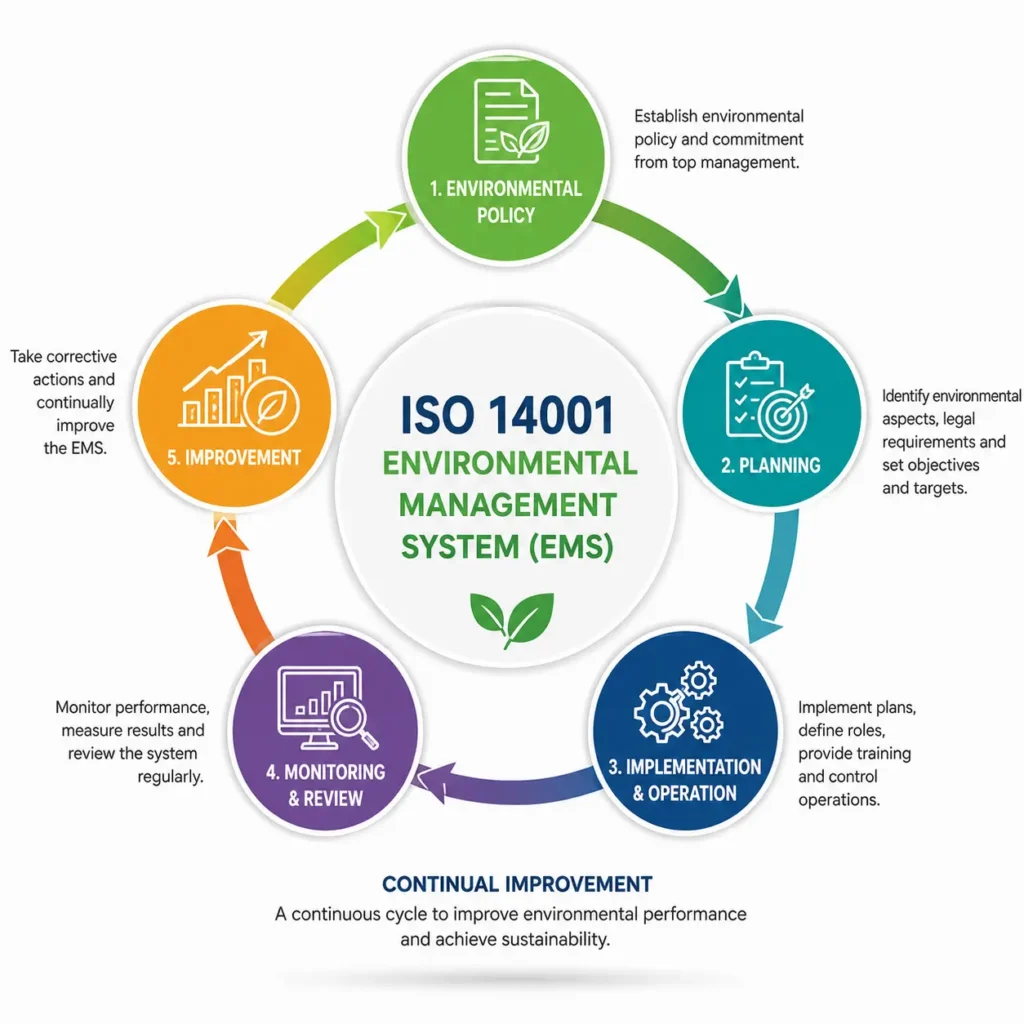
The basis of this standard is an ISO 14001 Environmental Management System (EMS).
Environmental Management System is the systematic way that enables organizations to manage their environmental performance by planning, implementing, monitoring and improving. The approach to deal with environmental issues is not separated but integrated within business operations through a systematic approach.
Having an effective Environmental Management System assists organisations to:
- Describe environmental aspects and impacts. .
- Minimize pollution and waste.
- Increase energy and resource efficiency.
- Adhere to environmental laws/regulations.
- Establish measurable environmental goals.
- Monitor environmental performance.
- Support continual improvement.
By integrating environmental management into daily operations, organizations can reduce risks while improving efficiency and sustainability.
Why ISO 14001 Is Important
Environmental management is not merely a matter of complying with the law. It has become a crucial component of customer trust, business reputation protection and business sustainable growth.
Implementing ISO 14001 can lead to better environmental performance and operational efficiency in organisations.
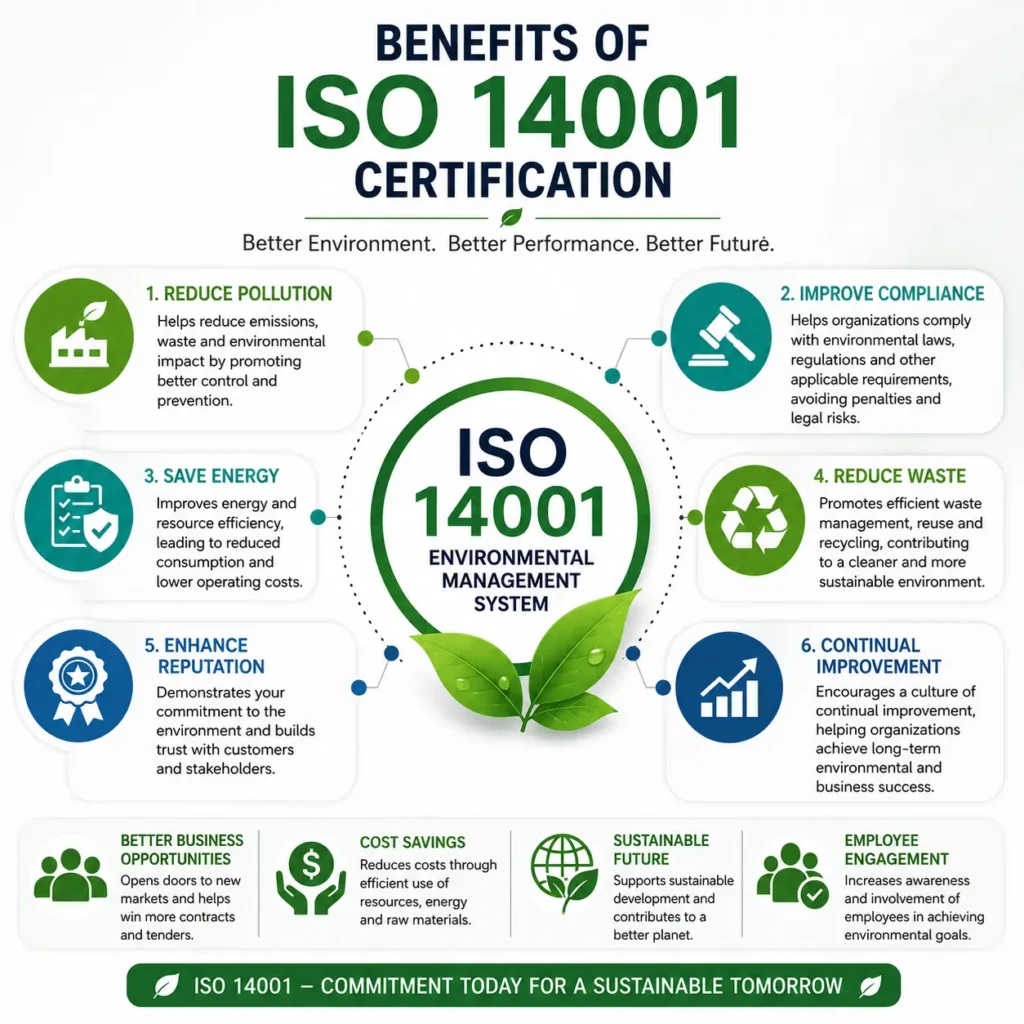
Key Benefits of ISO 14001
| Benefit | Business Value |
| Enhanced Environmental Performance | Minimises waste, emissions and environmental effects. |
| Legal Compliance | Supports organizations to comply with environmental laws. . |
| Energy Saving | Enhances energy efficiency and minimizes energy losses. |
| Better Reputation | Shows concern for the environment. |
| Improved Business Opportunities | Raises confidence of customers and stakeholders. |
| Continual Improvement | Promotes ongoing monitoring and improvement. |
Best environmental management practices are also seen to decrease resource use and boost the efficiency of operations for a lot of organisations, which leads to lower operating costs.
ISO 14001:2015 and the Latest Version
ISO 14001:2015 is a standard that is frequently encountered when searching for environmental standards. .
This is the most recent version of ISO 14001 in use, worldwide. The 2015 edition contained a number of significant new enhancements that highlight the importance of environmental management in an organisation’s business strategy.
Some of the major features are:
- More Executive Management involvement.
- Greater importance is put on environmental performance.
- Opportunity management and risk based thinking.
- Improved communication throughout the organization.
- Life cycle approach to the assessment of environmental impacts.
- Greater emphasis on continual improvement.
These enhancements allow organizations to be more than just in compliance and adopt a sustainable strategy over the long term.
The ISO 14001 Standard and Its Clauses
The ISO 14001standard is based on a five-part structured framework to assist organisations in the development and ongoing enhancement of an Environmental Management System..
The key clauses of ISO 14001 are:
| Clause | Purpose |
| Understand of the Organization | Knowledge of environmental issues and the needs of the organization. |
| Leadership | model management commitment and develop environment policies. |
| Planning | Identify risks, opportunities and environmental objectives. |
| Support | Ensure resources, training, communication and documentation. |
| Operation | Manage environmental processes and activities. |
| Performance Evaluation | Evaluate, monitor, measure, audit and review the environmental performance. |
| Improvement | Correct issues and continually improve the Environmental Management System. |
These are not individual requirements but rather are interlinked to form a holistic approach that enables organisations to improve their environmental performance over time.
ISO 14001 Certification: Why It Matters
It is fine for your company to have implemented an EMS; however, ISO 14001 certification proves to your clients, authorities, and other partners that you have had your system evaluated according to a certain international standard.
Certification provides evidence that your organisation is dedicated to effectively controlling environmental responsibilities and striving to continuously improve. It also gives assurance that your environmental processes are organized, tracked and reviewed on a regular basis.
Many organisations opt for certification for the benefit of their reputation, to enhance operational efficiency as well as to generate new business opportunities.
Benefits of ISO 14001 Certification
Successful ISO 14001 certification brings to an organisation a number of long term benefits, such as:
- Enhanced conformance to environmental regulations.
- Improved management of environmental risks.
- Reduced waste and resource consumption.
- Higher customer and stakeholder confidence.
- Improved local and international market reputation.
- Improved operational efficiency.
- Increased opportunities to win contracts and tenders.
- An attitude of continuous environmental enhancement.
Certification requires planning and effort, but the overall benefits for business and the environment in the long run could outweigh the cost of the effort.
ISO 14001 Certification in Saudi Arabia
In view of growing awareness about sustainability and environmental management, there has been an increasing need for ISO 14001 certification in Saudi Arabia. Environmental Management Systems are implemented in organizations that cover a wide range of industries like manufacturing, construction, oil & gas, logistics, healthcare, education, engineering and others.
Certification can also be a competitive edge for many companies. Many government projects and big private firms want to work with suppliers who adhere to internationally accepted management standards.
Saudi Arabia has also been promoting sustainable development for the last few years, which helps drive Environmental Best Practices among businesses. Adopting ISO 14001 will bring advantages to the organization to promote the business growth and improve its environmental performance.
How to Achieve ISO 14001 Certification
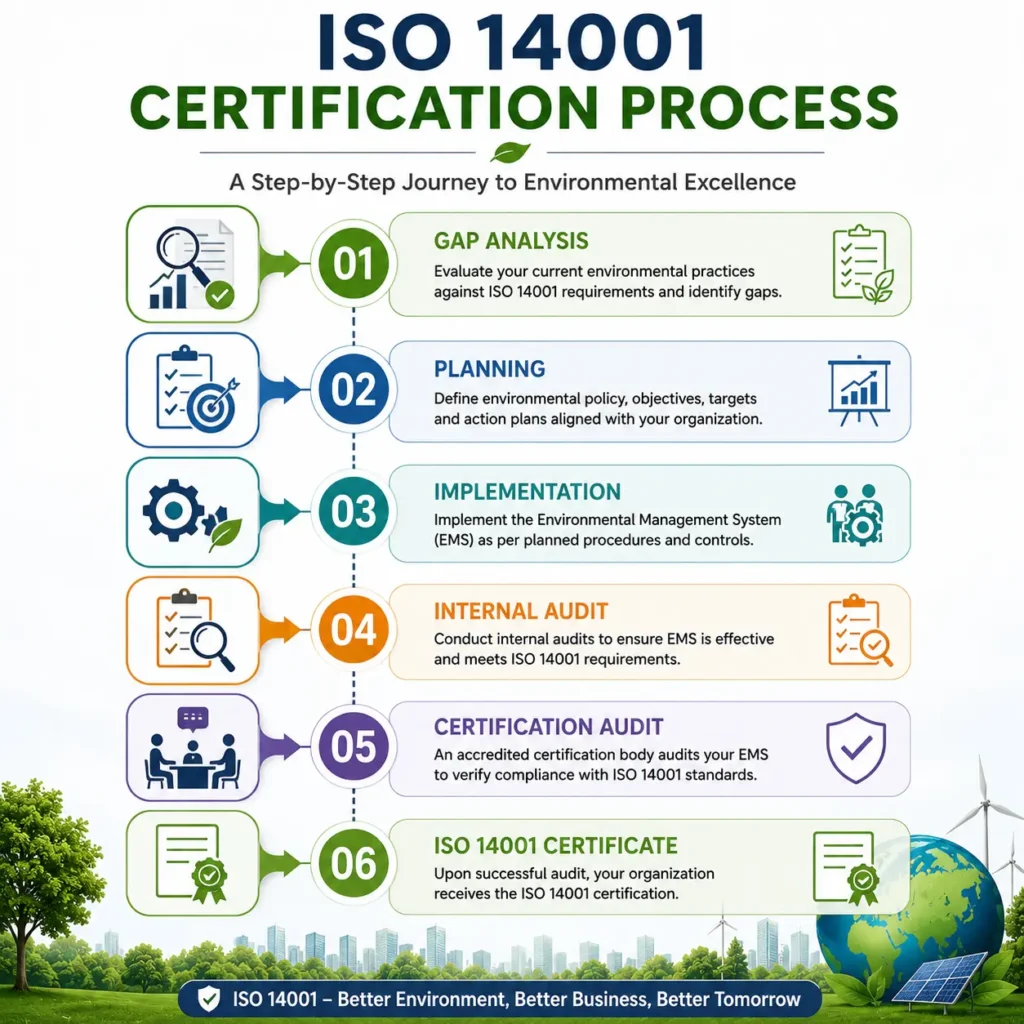
The certification process is a step-by-step procedure which needs planning, implementation and periodic evaluation. The process tends to go through the following stages, although each organization is unique.
1. Understand the Standard
The first step is to familiarize yourself with the ISO 14001 standard’s requirements, and see how they relate to your business.
2. Assess Current Practices
Review the current environmental procedures and establish the difference between the current practices and the ISO 14001 requirements.
3. Develop an Environmental Management System
Develop policies, objectives, operational procedures and documented information to assist with environmental management.
4. Train Employees
Staff should be aware of the organisation’s environmental policy and how their working life can help fulfil environmental goals.
5. Implementation of the System
Implement the Environmental Management System within all relevant departments.
6. Internal Auditing
Internal audit is performed in order to ensure that the system is working well, and to find ways to improve the system before the certification audit.
7. Perform Certification Audit
The Environmental Management System will be certified by an accredited certification body. Once all the criteria are met, the organisation will be awarded the ISO 14001 certificate.
ISO 14001 Lead Auditor
The ISO 14001 Lead Auditor is tasked with developing, performing and oversight of the audits for the Environmental Management System. These experts have a significant impact on the organization’s ability to meet the ISO 14001 requirements.
The auditors will be expected to know the requirements of the standard as well as know about environmental law, auditing methods and risk management. They audit by examining documents, conducting interviews, watching operations and creating comprehensive audit reports.
Environmental management professionals may seek ISO 14001 lead auditor certification to enhance auditing practices and advance their careers in the fields of compliance, consultancy and certification.
Typical implementation challenges
Organizations can gain many advantages from using ISO 14001, but there are a few challenges they can encounter when implementing the standard.
Common challenges include:
- Limited employee awareness.
- Incomplete environmental documentation.
- Difficulty identifying environmental aspects.
- Resistance to organizational change.
- Lack of management involvement.
- Training and monitoring due to resource constraint.
Luckily, all these problems could be effectively solved with proper planning, participation of employees, leadership, and assessment of the EMS.
Best Practices to Maintain ISO 14001 Certification
Getting certified is not enough. Companies should constantly strive to improve their EMS.
Some practical best practices include:
- Review environmental objectives regularly.
- Monitor environmental performance using measurable indicators.
- Conduct scheduled internal audits.
- Keep employees informed through ongoing training.
- Update procedures when regulations or business activities change.
- Encourage employees to report environmental improvement opportunities.
- Review system performance during management meetings.
- Implement corrective actions promptly whenever issues are identified.
These practices help organizations maintain certification while continuously improving environmental performance.
Conclusion
In this context, the adoption of environmental sustainability has turned into an obligation to responsible business management and ISO 14001 provides a practical way to help an organization achieve this objective. The adoption of an ISO 14001 Environmental Management System can help reduce the impact on the environment and also indicate the businesses’ commitment to continuous improvement and more efficient running of the business.
If your organization is looking for ISO 14001 Certification in Saudi Arabia, or wants to understand the ISO 14001 standard, or wants to learn how to become an ISO 14001 Auditor, there are long term environmental and business benefits to ISO 14001. Investing in employees, encouraging ongoing improvement and ensuring robust leadership will work to build a more sustainable future, and improve the reputation and competitiveness of the organization.
Frequently Asked Questions
Definition of ISO 14001?
The ISO 14001 standard is a guide that enables organizations to have environmental management systems. The system helps in setting up responsibilities to perform activities that benefit the environment. Adhere to the rules.
Meaning of ISO 14001?
ISO 14001 is a framework that helps organizations determine their activities that they can improve to be more environmental. Organizations can identify areas that they need improvement, come up with a strategy and implement them.
ISO 14001:2015?
ISO 14001:2015 is the name of the ISO 14001 Standard. It is the most recent version that companies globally use. It is used widely by most companies.
Definition of ISO 14001 Environmental Management System?
ISO 14001 Environmental Management System is a process which comprises policies, procedures and processes. These help organizations to be able to handle responsibilities with the aim of performing certain activities.
Whose implementation will ISO 14001 serve best?
ISO 14001 can be implemented by any organization regardless of its size, nature and type of business. The manufacturers, constructors, health institutions, education institutions and service providers are some examples.
How can a company obtain ISO 14001 certification in Saudi Arabia?
To get certified a company must set up an Environmental Management System. Then they check if it is working properly. Finally they need someone from a certification body to check and say it is okay.
What are the primary ISO 14001 clauses?
The key clauses in ISO 14001 include:
Context of the organization
Leadership
Planning
Support
Operations
Performance evaluation
Improvement
All the above-mentioned clauses help a company establish and operate its environmental management system.
What does an ISO 14001 Lead Auditor do?
An ISO 14001 lead auditor audits the environmental management system of a company. He or she makes sure that the company complies with the established rules and fulfills what it promised. Moreover, he or she brings to attention the shortcomings and proposes how to fix them.
Is ISO 14001 certification mandatory?
ISO 14001 certification is not mandatory for any company. However, many organizations still prefer to obtain the certification as it helps them to become environmentally-friendly and satisfy their customers.
What are the advantages of ISO 14001 certification?
The advantages of ISO 14001 certification include:
Environmentally-friendly approach
Compliance
Waste reduction
Building customers’ trust
Operational efficiency
Sustainable development.
All these advantages help an organization operate effectively and succeed.